
📰 Curated Industry Article
This is a summary of a full article from a trusted financial publication. Click “Read Full Article” below to read the complete story.
Key Takeaways
- Comparison sites make it easy to shop around for coverage with just a phone. Approximately 80% of car insurance applications in 2025 were completed on a mobile device, up from 77.5% in 2024, according to research from Luva, a car insurance comparison platform.
- Some comparison sites are licensed insurance agencies that offer real quotes, while others are lead-generation sites that gather your details and send them to an insurer or agent.
- Warning signs that a website is not legit include unusually low rates, high-pressure sales tactics and requests for alternative payments like gift cards, wire transfers or cryptocurrency.
When you’re trying to control your expenses, comparison shopping is key. That’s particularly true for auto insurance. More than half (58%) of U.S. insurance agents and brokers say comparing multiple insurance carriers before purchasing a policy is extremely or very important, according to an August 2026 survey by Luva, a car insurance comparison platform.
“Comparison sites let consumers see multiple options quickly and may show carrier options they had not considered,” says Mark Friedlander, senior director of media relations at the Insurance Information Institute.
But finding the right sites can be challenging. Plenty of insurance companies and comparison sites promise rock-bottom rates and instant coverage, so how can you tell the difference between a trustworthy site and one that’s just collecting your personal information?
Here’s what you need to know to buy a car insurance policy online with confidence.
Is it safe to buy car insurance online?
Buying car insurance online is generally safe as long as you’re purchasing coverage through a legitimate insurance agency, licensed insurer, agent or broker. Many well-known insurers and comparison sites let customers get quotes and buy policies entirely online, so you can shop for coverage and print proof of insurance within minutes.
Whether you purchase a full coverage policy or the state-mandated liability minimum, a policy that you buy online is just as valid as a policy you get through an insurance agent.
How do online car insurance companies and comparison sites work?
It’s important to distinguish between websites that sell insurance and those that collect and share your personal details with insurers, brokers or independent agents. They can be useful tools, but work very differently.
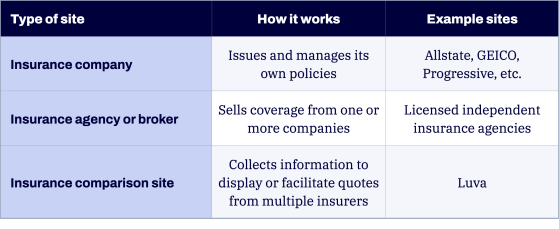
When shopping online, keep one major caveat in mind.
“Quotes are estimates, not binding offers,” cautions Friedlander.
A quote’s accuracy depends on the information you enter and your driving records, claims and credit history and other common rating factors, he says. If you share incomplete or inaccurate information, the final premium can differ from the initial quote.
How can you tell if an online insurance company is legitimate?
Before entering your personal information, follow these steps to verify that a company is above board.
1. Verify the company’s license
Every state requires insurers to be licensed to sell auto insurance policies.
If you’re working with an insurance agent or broker, you can check their licensing status through your state’s insurance department or the licensing lookup tools by the National Association of Insurance Commissioners (NAIC).
2. Look up the company’s insurance partners
In the case of car insurance comparison sites, look at the fine print at the bottom of the page. A reputable comparison site should explain whether they provide direct quotes, connect you with licensed agents or share your information with third parties. A company that’s licensed will also state that it’s a licensed producer in certain states.
For example, Luva Insurance Services is a licensed insurance producer in 49 states and the District of Columbia. Its partner insurers include Allstate, Farmers, GEICO, Liberty Mutual, Nationwide, Progressive and State Farm.
Check the fine print for information about the company’s licensing status, insurance partners and how it uses your personal information. Reputable comparison sites should clearly explain whether they provide quotes directly, connect you with licensed agents or share your information with third parties.
3. Research customer experience
When it comes to auto insurance companies, there are several resources to learn about the typical customer experience:
- Trustpilot: Trustpilot publishes customer reviews and ratings that can help you research insurers, comparison sites, brokers and agents
- NAIC Complaint Index: The National Association of Insurance Commissioners (NAIC) collects complaints that consumers submit to state regulators about insurers. Based on the company’s size, the NAIC issues a complaint index. If a company has an index above 1.00, it means that it has more complaints than expected for a company of its size.
- CRASH Network’s Insurer Report Card: CRASH Network surveys car repair shops nationwide, asking them to grade insurers based on their claims process, payment policies and how well they support for quality repairs.
A few bad reviews don’t mean a company isn’t reliable. Instead, look for common complaints or patterns — multiple complaints about similar issues could indicate an ongoing problem.
Warning signs to watch out for
Unfortunately, insurance scams exist and they can be very convincing. Here are some red flags to look for:
- Unrealistically low auto insurance rates
- Pressure to purchase immediately
- Unusual payment requests, such as wire transfers or cryptocurrency
- No verifiable licenses
- Website addresses that closely resemble those of established insurance companies
- Requests for sensitive personal or financial information before explaining how it will be used
Take the time to verify a company’s licensing and customer reviews. A little extra homework goes a long way to avoid online scams and buy insurance with peace of mind.
“Additionally, consumers should confirm coverage directly with the insurer (or their licensed agent) and obtain proof of insurance before considering the purchase of coverage final,” says Friedlander.
Check the policy’s effective date, download your proof of insurance, and if you’re switching insurers, don’t cancel your existing policy until the new coverage takes effect.
FAQ
Is online car insurance cheaper than buying through an agent?
Not always. Shopping online makes it easy to compare car insurance rates online, but your premiums vary based on your driving record, vehicle and coverage.
Can I get same-day car insurance online?
Yes, many insurers allow you to compare car insurance quotes and purchase coverage online within minutes. Once you’ve paid your premium, you can often print proof of insurance online right away.
How accurate are online car insurance quotes?
An online quote is typically an estimate. Your final premium may be different once you share your claims history, driver’s license and vehicle identification number (VIN). To get the most accurate quote, provide accurate information, including details of past accidents or traffic tickets, and confirm the final rate before purchasing.
💡 What This Means For You
[afc_dynamic_insight]
ANNUITY FACTCHECK
Your Financial Security Starts Here
Whether you’re exploring fixed, variable, or indexed annuities — we provide the clear, unbiased information you need to protect your future.
📰 This article is sourced from a trusted financial publication. AnnuityFactCheck shares this for informational purposes only. Always consult a licensed financial advisor for personalized guidance.