
📰 Curated Industry Article
This is a summary of a full article from a trusted financial publication. Click “Read Full Article” below to read the complete story.
The federal government has announced cost-of-living adjustments for the Supplemental Nutrition Assistance Program, or SNAP, that will give millions of Americans a boost to their food stamps.
Every year, the announcement of the Social Security cost-of-living adjustment (COLA) grabs the attention of America’s retirees and people with disabilities. The SNAP COLA, set to take effect Thursday (Oct. 1), doesn’t receive as much fanfare.
Cost-of-living adjustments are supposed to prevent inflation from eroding the spending power that comes from benefit programs. The SNAP COLA adjustments are lower than the current inflation rate of 3.4%, but higher than “food at home” inflation (2.2%).
The maximum monthly “allotments,” or benefits, will increase by between 2.7% and 3.2%, according to an Aug. 21 memo from the U.S. Department of Agriculture. That works out to increases of between $6.43 and $8 per person, depending on household size.
Must Read
-
Meet your financial goals faster: Take this free, no-obligation quiz to get matched with an advisor today.
-
You’re probably eligible to save money on car insurance. Compare rates for your ZIP code with this free — and fast — tool from Money.
-
Investors have historically used gold to hedge against inflation — and that trend continues today. Get in on the action with American Hartford Gold’s free guide.
Starting next month, a family of four can receive up to $1,023 a month in SNAP benefits, an increase of $29 — or $7.25 per person. The max benefit for an individual will rise to $306 per month, an $8 increase.
The COLA doesn’t help only SNAP recipients who receive the max benefits. Households receiving less than the maximum generally stand to see similar dollar increases from the adjustment.
The USDA bases the adjustments to maximum monthly SNAP benefits on consumer price index inflation data and the Thrifty Food Plan (TFP), a government estimate of what it costs a four-person family to support a nutritious, budget-friendly diet.
Here are the changes taking effect in the 48 contiguous states and Washington, D.C.:
“The calculation takes economies of scale into account,” a USDA webpage explains. “Smaller households get slightly more per person than the four-person household. Households larger than four people get slightly less per person.”
The average SNAP benefit was $188 per person in fiscal year 2025, according to the USDA, and there were 36.4 million SNAP participants in June 2026.
2027 income limits for SNAP
Every October, the USDA also updates SNAP’s income limits for inflation. This year’s increases range from 1.9% to 3.4%, depending on household size.
Here are the old and new gross monthly income limits to qualify for SNAP, which are set at 130% of the poverty line. Keep in mind that net income limits also apply, and state eligibility rules vary.
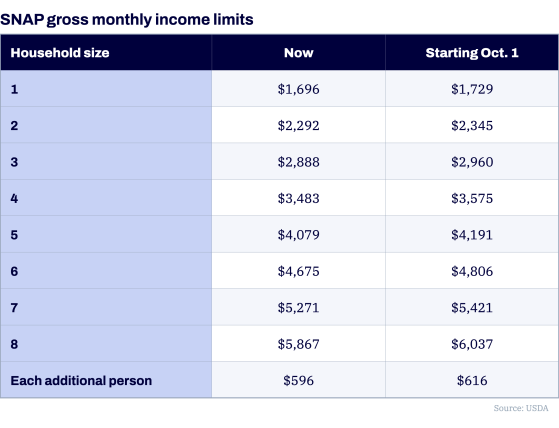
SNAP cuts in last year’s “Big, Beautiful” bill made it harder to qualify for benefits by expanding work requirements. Many SNAP participants under the age of 65 without young kids must now work or complete approved activities (such as volunteering or training) for at least 80 hours per month to keep receiving their benefits. The number of SNAP participants decreased by about 12.8% from June 2025 to June 2026.
Never miss a Money story.
- Join 700,000+ readers who get the latest financial news and advice delivered daily inbox for free. Subscribe to our newsletters.
💡 What This Means For You
[afc_dynamic_insight]
ANNUITY FACTCHECK
Your Financial Security Starts Here
Whether you’re exploring fixed, variable, or indexed annuities — we provide the clear, unbiased information you need to protect your future.
📰 This article is sourced from a trusted financial publication. AnnuityFactCheck shares this for informational purposes only. Always consult a licensed financial advisor for personalized guidance.